
www.usa-automation.net
10
'26
Written on Modified on
Kawasaki Enhances Cybersecurity for Industrial Robots
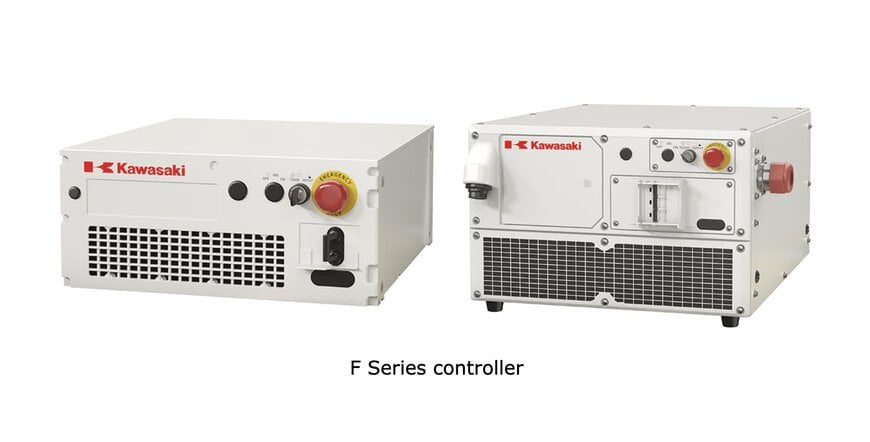
The F Series S-type controller for industrial robots features enhanced functions designed to counter cyberattacks and other security threats.
www.kawasakirobotics.com
The rapid integration of Industrial Internet of Things (IIoT) platforms, cloud analytics, and remote maintenance gateways has transformed manufacturing cells from air-gapped islands into interconnected network nodes. While horizontal and vertical network connectivity optimizes equipment uptime and allows real-time production monitoring, it simultaneously exposes operational technology (OT) infrastructure to unauthorized lateral movement, malicious code injection, and data exfiltration. Historically, industrial robot automation prioritized functional personnel safety—such as emergency stops, speed and separation monitoring, and interlocked physical fencing—while treating internal controller firmware, teaching-pendant configurations, and engineering communication buses as trusted, unencrypted environments. In connected smart factories, an unprotected controller can allow adversaries to alter kinematic motion parameters, spoof sensor feedback, or compromise intellectual property via intercepted robot programs. Furthermore, evolving regulatory regimes, including the European Union Cyber Resilience Act and the updated EU Machinery Regulation, are shifting industrial equipment certification from purely mechanical and functional safety to mandatory lifecycle cyber resilience. Addressing these vulnerabilities requires hardened controller architectures that unite functional safety fieldbuses with hardware-level security, cryptographic session controls, and auditable user privileges.
Hardware Integrity and Identity-Based Access Controls
To protect connected robotics installations against expanding cyberattack vectors, Kawasaki Heavy Industries announced the commercial release of the F Series Controller S-type. The newly engineered unit inherits the kinematic motion algorithms, physical expandability, and teaching-pendant operability of Kawasaki’s widely deployed F Series controller platform while embedding multi-layered cybersecurity countermeasures directly into the execution environment.
The system addresses unauthorized parameter changes and credential harvesting by establishing granular user authentication through individual usernames and passwords, coupled with role-based access privilege management. This configuration separates standard shop-floor operational routines from restricted engineering, calibration, and safety configuration permissions. To maintain operational traceability, the controller records comprehensive operation and security event logs, allowing security operations and plant maintenance teams to audit system changes or trace anomalous behaviors during post-incident forensics. Network data in transit is protected through secure, encrypted communication protocols, including SSH, FTPS, and HTTPS, alongside configurable service restrictions and packet filtering. To prevent the installation of unauthorized firmware or weaponized rootkits, the S-type enforces cryptographic integrity verification during operating system startup and applies application execution control to prevent arbitrary or unsigned binaries from executing on the controller.
Integrated Functional Safety and Certified Development Lifecycles
Rather than isolating cybersecurity from traditional plant safety, the F Series Controller S-type unifies physical operator protection with digital defense mechanisms. The controller maintains the safety control technologies of the baseline F Series, providing native support for the PROFIsafe communication protocol over industrial Ethernet. This unified safety and security framework enables machine builders to manage safe operational stops, limited speeds, and zone monitoring without routing sensitive safety signals across unverified network bridges.
Kawasaki developed the F Series Controller S-type under product-development processes certified to the international standard IEC 62443-4-1 (Security for industrial automation and control systems - Secure product development lifecycle requirements). By aligning development pipelines with certified security lifecycle practices, Kawasaki provides continuous vulnerability management, coordinated disclosure workflows, and verified patch delivery frameworks, helping equipment integrators and manufacturing end-users comply with tightening regulatory expectations under the EU Machinery Regulation and the Cyber Resilience Act.
Additional Context
This section details technical specifications and competitive benchmarking not included in the original product announcement.
In industrial automation and robot control systems governed by the IEC 62443 cybersecurity standard family and ISO 10218-1/2 robot safety standards, a foundational distinction exists between functional safety (preventing physical harm from equipment failure) and cybersecurity (preventing intentional electronic compromise). Functional safety protocols like PROFIsafe, CIP Safety, and Safety over EtherCAT utilize black-channel communication principles, ensuring that data transmission corruption or frame loss triggers a safe state; however, black-channel safety layers do not provide confidentiality or cryptographic authentication against adversary-in-the-middle attacks. Bridging this gap in an embedded controller requires implementing a hardware Root of Trust, typically via a dedicated Trusted Platform Module (TPM 2.0) or secure bootloader element that verifies cryptographic digital signatures before loading the real-time operating system kernel. Once booted, application whitelisting and mandatory access controls prevent unauthorized process execution, while public-key cryptography authenticates remote administrative connections. Additionally, the European Union Cyber Resilience Act introduces strict requirements for Software Bills of Materials (SBOM), automated vulnerability notification windows, and secure-by-default factory configurations, preventing the historical practice of deploying automation hardware with shared default administrative passwords.
Within the industrial robotics automation landscape, Kawasaki’s F Series Controller S-type benchmarks directly against hardened controller architectures from primary industrial robot manufacturers, including FANUC (R-30iB Plus with enhanced network security and user authentication), ABB (OmniCore controller family, which features built-in cybersecurity with secure boot, certificate management, and IEC 62443 conformance), KUKA (KR C5 controller running KUKA.DeviceConnector and hardened VxWorks architectures), and Yaskawa Electric (YRC1000 controller with network security options). While competitors such as ABB’s OmniCore integrate digital certificates and encrypted communications natively across modern ultra-compact enclosures, many older factory deployments still rely on external industrial firewalls or peripheral OT security appliances (such as mGuard or Hirschmann security routers) placed ahead of legacy robot cabinets to filter malicious traffic. By embedding secure OS verification, encrypted service daemons, and IEC 62443-4-1 compliant lifecycle management directly into the native F Series enclosure, Kawasaki eliminates the requirement for auxiliary external security gateways, providing automotive assembly lines, heavy shipbuilding cells, and general manufacturing facilities with an intrinsically resilient control node built to withstand evolving industrial network exploits.
Edited by Romila DSilva, Induportals Editor, with AI assistance.
www.kawasaki.com
