
www.usa-automation.net
06
'26
Written on Modified on
New automated solution to cut NVH test time from days to hours
Siemens’ new automated component model extraction solution industrializes blocked force extraction and supports more accurate system-level NVH prediction through virtual prototyping.
www.siemens.com
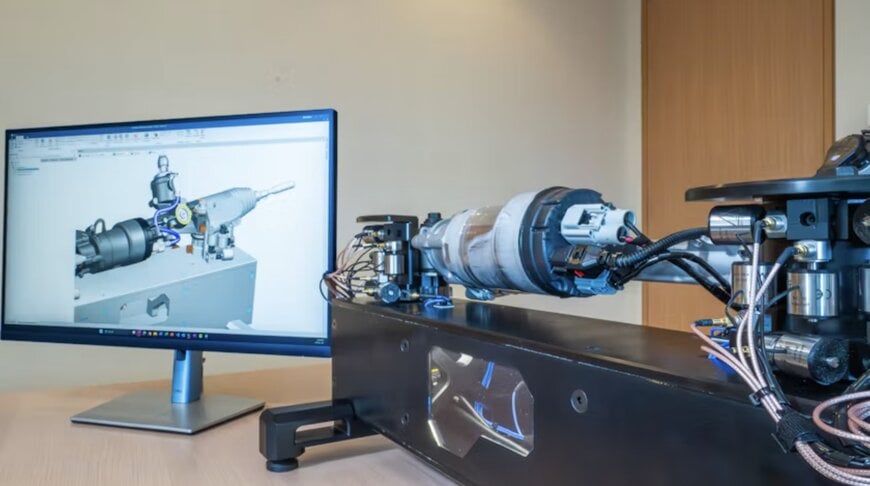
Automated component model extraction uses a self-measuring fixture where rigid virtual-point adapters carry a permanently mounted set of shakers and accelerometers, an automation control unit wired through an amplifier and a Simcenter SCADAS frontend to a laptop running Simcenter Testlab
Vehicle electrification and industrial precision engineering have heightened the acoustic scrutiny placed on ancillary electro-mechanical sub-assemblies. With the elimination of internal combustion engine masking noise, high-frequency tonal whine, harmonic gear meshing orders, and structure-borne vibrations originating from electric power steering mechanisms, thermal management pumps, refrigerant compressors, and mechatronic actuators propagate directly into vehicle passenger cabins and structural chassis. Historically, predicting how a specific auxiliary unit will behave when mounted in a vehicle required late-stage physical prototyping or highly specialized, manual transfer path analysis campaigns. Component characterization has traditionally been slow, labor-intensive, and operator-dependent, where physical impact hammer testing or manual shaker excitation introduced operator variability and measurement scatter. These inconsistencies prevented mechanical engineers from obtaining reliable, invariant component descriptors, ultimately compromising downstream virtual assembly and Digital Twin simulation accuracy. Overcoming these bottlenecks requires automated, standardized hardware-software test benches capable of executing multi-axis excitations and matrix inversions within controlled, repeatable workflows.
Industrializing Invariant Blocked Force Extraction with Bosch Technology
To resolve the throughput and reproducibility challenges of noise, vibration, and harshness (NVH) testing, Siemens announced an integrated hardware and software solution for automated component model extraction, standardizing the workflow in strict accordance with the ISO 20270 standard. Developed in technical collaboration with Bosch, the solution builds on Bosch's patented predictiveVIA technology, with Siemens serving as the sole industrialized and commercialized implementation partner.
The system pairs automated test benches with dedicated software to streamline the derivation of simulation-ready component models that remain independent of the receiving boundary conditions. By replacing manual acoustic excitation with automated sequential shaker configurations and robotic fixture management, the architecture executes frequency response function (FRF) measurements in hours or minutes rather than days or weeks, achieving a 93 percent reduction in measurement cycle times while delivering 100 percent repeatability across component batches. This automated consistency eliminates experimental variance between test technicians, allowing original equipment manufacturers and Tier-1 suppliers to exchange invariant source characterizations that can be dropped directly into virtual system integration pipelines to catch defective or off-nominal components before physical vehicle integration.
Simcenter Integration and Virtual Prototype Assembly
The automated component model extraction platform integrates natively within Siemens' Simcenter physical testing portfolio, combining Simcenter Testlab data acquisition and processing software with Simcenter SCADAS multi-channel measurement hardware and Simcenter Qsources acoustic and structural excitation transducers.
The platform supports both empirical test-based characterization and hybrid computer-aided engineering (CAE) representations for components such as traction motors, electronic power steering racks, braking actuators, fluid pumps, and air conditioning compressors. Once extracted, the invariant blocked force models feed directly into Simcenter Testlab Virtual Prototype Assembly workflows, where engineers can couple component models with structural transfer functions of subframes and vehicle body-in-white structures. This enables accurate key performance indicator prediction and multi-attribute NVH auralization in the Simcenter Testlab NVH Simulator, allowing development teams to evaluate structural modifications, such as comparing elastomeric mount stiffnesses or evaluating structural ribbing, without relying on drivable physical prototypes.
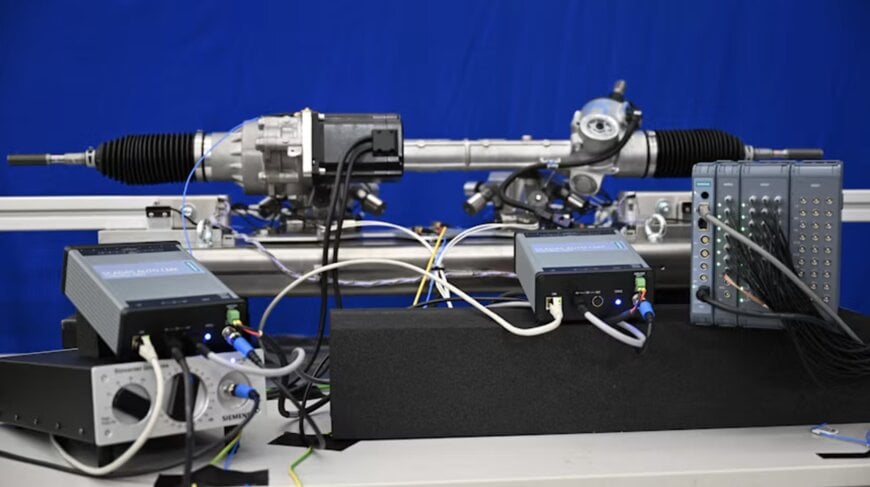
As all instrumentation lives on the fixture, nothing is attached to the component under test. Swapping a part means unbolting the previous unit and bolting on the next, enabling genuine batch throughput
Additional Context
This section details technical specifications and competitive benchmarking not included in the original product announcement.
In dynamic substructuring and component-based Transfer Path Analysis (TPA), characterizing an active vibrating source independently from its receiver structure is governed by ISO 20270, which outlines the determination of invariant blocked forces and source descriptors. Historically, contact interface forces between a source and a receiver varied depending on the local compliance and impedance of the test fixture or vehicle body. Blocked forces circumvent this limitation by representing the theoretical forces an active component would exert if bolted to an infinitely rigid foundation, rendering them an intrinsic property of the component itself. However, measuring blocked forces on truly rigid test benches is practically impossible at higher acoustic frequencies due to internal fixture resonances. The in-situ method formalized in ISO 20270 solves this by measuring operational indicator responses on a resiliently mounted receiver, followed by an inversion of the passive frequency response function matrix between interface virtual points and indicator sensors. The mathematical transformation relies on Virtual Point Transformation (VPT), which condenses multiple multi-axis sensor channels around each mechanical mounting bolt into six degrees of freedom, encompassing three translational and three rotational coordinates. Because matrix inversion is notoriously sensitive to experimental noise, rank deficiency, and sensor misalignment, automated robotic excitation ensures high coherence across all interface degrees of freedom, eliminating the need for ill-conditioned regularization or subjective filtering.
Within the digital engineering, test, and structural acoustics landscape, Siemens' automated component model extraction platform benchmarks against specialized test-based engineering solutions from HBK (Hottinger Brüel & Kjær, featuring the BK Connect platform and PULSE multi-analyzer systems), Dewesoft, and HEAD acoustics (specifically the ArtemiS SUITE transfer path analysis modules), alongside CAE-centric substructuring toolsets from Altair (OptiStruct) and Ansys (Sound and Mechanical). While providers such as HBK and HEAD acoustics offer advanced multi-channel data acquisition systems and manual in-situ TPA software modules, their implementations remain largely operator-driven, requiring skilled test engineers to manually position roving impact hammers or reposition individual electrodynamic shakers across dozens of excitation points. This manual bottleneck has historically prevented automotive Tier-1 suppliers from adopting blocked forces as routine quality-gate metrics on production batches. By integrating Bosch's patented predictiveVIA workflow into dedicated automated test benches with Simcenter Testlab and SCADAS hardware, Siemens establishes an industrialized, turnkey test environment. This bridges the gap between physical end-of-line acoustic testing and front-loaded virtual simulation, allowing engineering organizations to enforce contractually binding blocked force specifications across digital supplier networks.
Edited by Romila DSilva, Induportals Editor, with AI assistance.
Vehicle electrification and industrial precision engineering have heightened the acoustic scrutiny placed on ancillary electro-mechanical sub-assemblies. With the elimination of internal combustion engine masking noise, high-frequency tonal whine, harmonic gear meshing orders, and structure-borne vibrations originating from electric power steering mechanisms, thermal management pumps, refrigerant compressors, and mechatronic actuators propagate directly into vehicle passenger cabins and structural chassis. Historically, predicting how a specific auxiliary unit will behave when mounted in a vehicle required late-stage physical prototyping or highly specialized, manual transfer path analysis campaigns. Component characterization has traditionally been slow, labor-intensive, and operator-dependent, where physical impact hammer testing or manual shaker excitation introduced operator variability and measurement scatter. These inconsistencies prevented mechanical engineers from obtaining reliable, invariant component descriptors, ultimately compromising downstream virtual assembly and Digital Twin simulation accuracy. Overcoming these bottlenecks requires automated, standardized hardware-software test benches capable of executing multi-axis excitations and matrix inversions within controlled, repeatable workflows.
Industrializing Invariant Blocked Force Extraction with Bosch Technology
To resolve the throughput and reproducibility challenges of noise, vibration, and harshness (NVH) testing, Siemens announced an integrated hardware and software solution for automated component model extraction, standardizing the workflow in strict accordance with the ISO 20270 standard. Developed in technical collaboration with Bosch, the solution builds on Bosch's patented predictiveVIA technology, with Siemens serving as the sole industrialized and commercialized implementation partner.
The system pairs automated test benches with dedicated software to streamline the derivation of simulation-ready component models that remain independent of the receiving boundary conditions. By replacing manual acoustic excitation with automated sequential shaker configurations and robotic fixture management, the architecture executes frequency response function (FRF) measurements in hours or minutes rather than days or weeks, achieving a 93 percent reduction in measurement cycle times while delivering 100 percent repeatability across component batches. This automated consistency eliminates experimental variance between test technicians, allowing original equipment manufacturers and Tier-1 suppliers to exchange invariant source characterizations that can be dropped directly into virtual system integration pipelines to catch defective or off-nominal components before physical vehicle integration.
Simcenter Integration and Virtual Prototype Assembly
The automated component model extraction platform integrates natively within Siemens' Simcenter physical testing portfolio, combining Simcenter Testlab data acquisition and processing software with Simcenter SCADAS multi-channel measurement hardware and Simcenter Qsources acoustic and structural excitation transducers.
The platform supports both empirical test-based characterization and hybrid computer-aided engineering (CAE) representations for components such as traction motors, electronic power steering racks, braking actuators, fluid pumps, and air conditioning compressors. Once extracted, the invariant blocked force models feed directly into Simcenter Testlab Virtual Prototype Assembly workflows, where engineers can couple component models with structural transfer functions of subframes and vehicle body-in-white structures. This enables accurate key performance indicator prediction and multi-attribute NVH auralization in the Simcenter Testlab NVH Simulator, allowing development teams to evaluate structural modifications, such as comparing elastomeric mount stiffnesses or evaluating structural ribbing, without relying on drivable physical prototypes.
As all instrumentation lives on the fixture, nothing is attached to the component under test. Swapping a part means unbolting the previous unit and bolting on the next, enabling genuine batch throughput
Additional Context
This section details technical specifications and competitive benchmarking not included in the original product announcement.
In dynamic substructuring and component-based Transfer Path Analysis (TPA), characterizing an active vibrating source independently from its receiver structure is governed by ISO 20270, which outlines the determination of invariant blocked forces and source descriptors. Historically, contact interface forces between a source and a receiver varied depending on the local compliance and impedance of the test fixture or vehicle body. Blocked forces circumvent this limitation by representing the theoretical forces an active component would exert if bolted to an infinitely rigid foundation, rendering them an intrinsic property of the component itself. However, measuring blocked forces on truly rigid test benches is practically impossible at higher acoustic frequencies due to internal fixture resonances. The in-situ method formalized in ISO 20270 solves this by measuring operational indicator responses on a resiliently mounted receiver, followed by an inversion of the passive frequency response function matrix between interface virtual points and indicator sensors. The mathematical transformation relies on Virtual Point Transformation (VPT), which condenses multiple multi-axis sensor channels around each mechanical mounting bolt into six degrees of freedom, encompassing three translational and three rotational coordinates. Because matrix inversion is notoriously sensitive to experimental noise, rank deficiency, and sensor misalignment, automated robotic excitation ensures high coherence across all interface degrees of freedom, eliminating the need for ill-conditioned regularization or subjective filtering.
Within the digital engineering, test, and structural acoustics landscape, Siemens' automated component model extraction platform benchmarks against specialized test-based engineering solutions from HBK (Hottinger Brüel & Kjær, featuring the BK Connect platform and PULSE multi-analyzer systems), Dewesoft, and HEAD acoustics (specifically the ArtemiS SUITE transfer path analysis modules), alongside CAE-centric substructuring toolsets from Altair (OptiStruct) and Ansys (Sound and Mechanical). While providers such as HBK and HEAD acoustics offer advanced multi-channel data acquisition systems and manual in-situ TPA software modules, their implementations remain largely operator-driven, requiring skilled test engineers to manually position roving impact hammers or reposition individual electrodynamic shakers across dozens of excitation points. This manual bottleneck has historically prevented automotive Tier-1 suppliers from adopting blocked forces as routine quality-gate metrics on production batches. By integrating Bosch's patented predictiveVIA workflow into dedicated automated test benches with Simcenter Testlab and SCADAS hardware, Siemens establishes an industrialized, turnkey test environment. This bridges the gap between physical end-of-line acoustic testing and front-loaded virtual simulation, allowing engineering organizations to enforce contractually binding blocked force specifications across digital supplier networks.
Edited by Romila DSilva, Induportals Editor, with AI assistance.
www.siemens.com
