
www.usa-automation.net
25
'26
Written on Modified on
Virtual PLC Runtime for Secure Windows Engineering and CI Testing
Beckhoff TwinCAT 3 Usermode Runtime runs PLC programs without real-time kernel drivers on restricted Windows engineering systems.
www.beckhoff.com
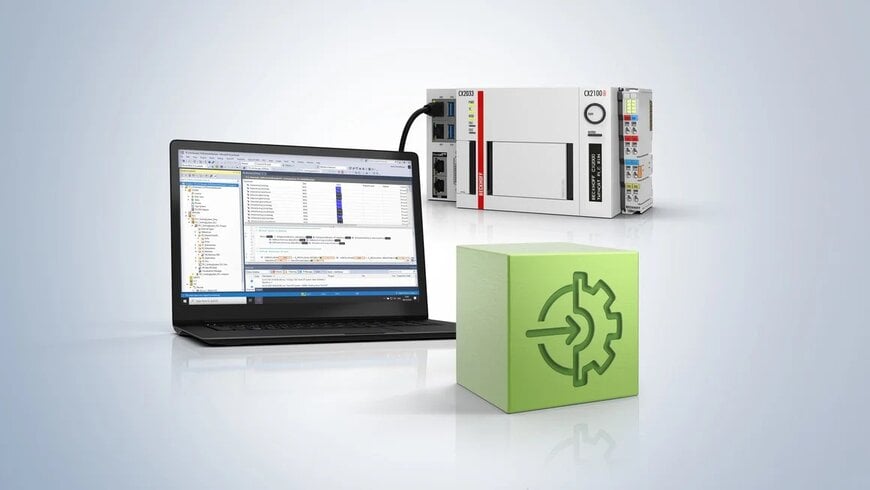
Engineering workstations in automation projects are increasingly subject to the same IT security policies as office PCs. Hardened Windows configurations can block the installation or operation of a real-time runtime, which prevents control engineers from executing and testing PLC code locally. With the TwinCAT 3 Usermode Runtime, Beckhoff provides a way to run TwinCAT applications in the user mode of the operating system, aimed at software development, testing and simulation in machine building and industrial automation.
Security Requirements in Windows-Based Control Engineering
System requirements in Windows environments are changing, mostly as a result of security considerations, and these changes also have to be taken into account in control engineering. The classic TwinCAT real-time runtime is deeply integrated into the operating system to achieve deterministic cycle times. On engineering systems where the installation or operation of this real-time runtime is not permitted, developers have so far had limited options for executing their programs before commissioning.
How the TwinCAT 3 Usermode Runtime Works
The TwinCAT 3 Usermode Runtime (TC1700) executes customer programs in the user mode of the operating system instead of in a real-time context. Applications programmed in TwinCAT therefore run without real-time properties, but they can also be executed in more restrictively configured Windows environments. The runtime mode is selected during installation, and the deep integration into the TwinCAT Package Manager makes its use almost invisible to the developer. The software can be used free of licence costs and only requires (trial) licences for the TwinCAT products used in the application.
Controlling Execution Timing with External Control and Fast As Possible
Two options give users control over the timing of the PLC program. External Control (TC1701) provides an interface through which an external application clocks the execution of the control program, enabling synchronisation with other programs such as simulation models. Fast As Possible (TC1702) runs the application as fast as the underlying hardware allows, while simulating different cores and cycle timings. This makes it possible to preview the calculated results of an application ahead of real time, for example when validating control algorithms.
Restricted Runtime for CI/CD and Simulation Pipelines
Both options are included in the new TwinCAT 3 Restricted Runtime (TC399x), which Beckhoff developed specifically for multi-hour use in continuous integration (CI), continuous deployment (CD) and simulation processes. The licence allows flexible, recurring use in development and test environments, but not in productive operation. To enforce this, an integrated sanction function automatically switches the software into TwinCAT configuration mode after six hours of runtime and stops program execution. A new start, which can be repeated as often as required, allows a further six hours of use.
Applications in Automation Software Development
For machine builders and automation software teams, the combination addresses several typical workflow needs: running and debugging PLC code on locked-down engineering laptops, executing automated regression tests on build servers, and coupling control logic to simulation models for virtual commissioning. Because user-mode execution is not deterministic, the runtime is intended for development and testing, while production machines continue to run on the TwinCAT real-time runtime.
Additional Context:
This section details technical specifications and competitive benchmarking not included in the original product announcement.
Software-in-the-loop testing and virtual commissioning are established practices in automation engineering, and comparable tools exist from other vendors, for example Siemens S7-PLCSIM Advanced for simulating SIMATIC S7-1500 controllers and CODESYS Control Win as a Windows-based soft PLC. At the same time, Windows security features such as virtualisation-based security and memory integrity (HVCI) restrict which kernel drivers can be loaded, which is one reason why user-mode execution is gaining relevance on engineering PCs. Industrial security standards such as IEC 62443-4-1 also place increasing emphasis on a secure development lifecycle for automation software, in which automated CI/CD testing plays a growing role.
Edited by Natania Lyngdoh, Induportals editor, with AI assistance.
www.beckhoff.com
