
Danfoss debuts high-density liquid cooling at Supercomputing 2026
The company will introduce the CoolTrain 2 system and advanced FD83 couplings for AI server racks.
www.danfoss.com
Danfoss will present its comprehensive portfolio of data center cooling, power, and energy management technologies at the Supercomputing (SC) 2026 exhibition in Chicago from November 16 to 19. Under the theme "You run the data. We keep it cool," the company aims to address the unprecedented thermal challenges driven by artificial intelligence and high-performance computing (HPC) workloads. By optimizing both white space and gray space infrastructure—spanning from the electrical grid to the server rack and downstream heat recovery—Danfoss is positioning itself as a strategic partner for operators looking to scale AI-ready facilities rapidly without sacrificing energy efficiency or system reliability.
New hardware for high-capacity liquid cooling
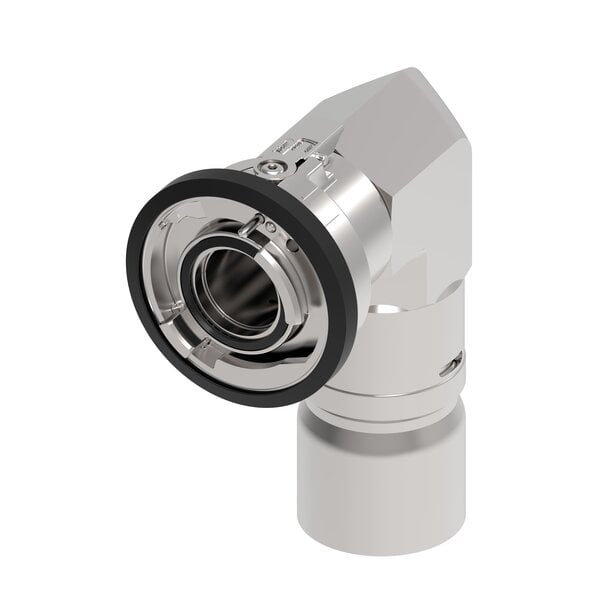
During the event, Danfoss will launch several critical hardware components engineered specifically for high-density liquid cooling architectures. Key debuts include the CoolTrain™ 2, a customizable plug-and-play solution capable of managing up to 233 kW of liquid cooling power. To safely route coolant to these massive thermal loads, the company is introducing the Hansen® FD83 2.5-inch quick-disconnect coupling, which delivers nearly twice the flow rate of previous generations while significantly reducing pressure drop. Additionally, Danfoss will showcase its new e-QC and e-PC stainless steel smart control valves, which electronically balance coolant flows up to 333 liters per minute (88 gpm), utilizing integrated NovoCon® M2 digital actuators to provide dynamic control and real-time DCIM telemetry.
Additional Context: Fluid dynamics, pressure drop, and quick-disconnect hydrodynamics
This section details the physical principles of liquid cooling and hydraulic resistance not included in the original press release.
In high-density AI data centers, transitioning from air cooling to direct-to-chip liquid cooling involves managing complex fluid dynamics within the server rack. As coolant is pumped through a dense network of hoses, microchannel cold plates, and manifolds, it encounters frictional resistance against the internal walls of the plumbing, known as pressure drop. According to the principles of fluid mechanics, pressure drop increases quadratically with flow velocity. If the pressure drop across a rack is too high, the Coolant Distribution Unit (CDU) pumps must work exponentially harder, consuming excessive electrical power and potentially causing cavitation or mechanical pump failure.
Quick-Disconnect (QD) couplings are critical inflection points in this hydraulic circuit. They allow operators to safely hot-swap AI servers without shutting down the entire cooling loop or spilling conductive fluids onto energized electronics. However, the internal shut-off valving mechanisms of standard QDs create severe localized flow restrictions. By engineering larger 2.5-inch QDs with optimized internal geometries, manufacturers dramatically reduce this hydraulic resistance. This enables the massive volumetric flow rates required to extract hundreds of kilowatts of heat from modern AI clusters, all while keeping the primary pump energy consumption strictly minimized and ensuring no servers are starved of coolant.
Edited by an industrial journalist, Lekshman Ramdas, with AI assistance.
www.danfoss.com
