
www.usa-automation.net
05
'26
Written on Modified on
Boston Dynamics Launches Next Generation Stretch Robot
Stretch Gen 2 introduces major hardware and structural upgrades engineered to maximize uptime and streamline maintenance in high-volume logistics environments.
bostondynamics.com
Trailer and shipping container unloading represents one of the most physically demanding, hazardous, and labor-constrained operations within modern supply-chain logistics. Manual case unloading subjects warehouse workers to repetitive heavy lifting, ergonomic strain, and extreme temperatures inside unconditioned trailer bays, resulting in high employee turnover and elevated injury rates. While automated mobile manipulation platforms offer a path to continuous inbound dock operations, early robotic implementations have faced significant reliability bottlenecks. Rapid acceleration cycles, continuous multi-axis mechanical torque, and driving over uneven dock levelers subject internal wiring harnesses and electrical connectors to severe vibration fatigue, leading to intermittent signal failures and unscheduled downtime. Furthermore, complex, tightly bundled internal cabling often turns routine repairs into multi-hour or full-day maintenance events that halt receiving throughput. Overcoming these dockside disruptions demands hardened mechanical architectures engineered for vibration resistance, continuous kinematic motion, modular component field-swaps, and streamlined internal routing.
Hardened Architecture and Modular Field Serviceability
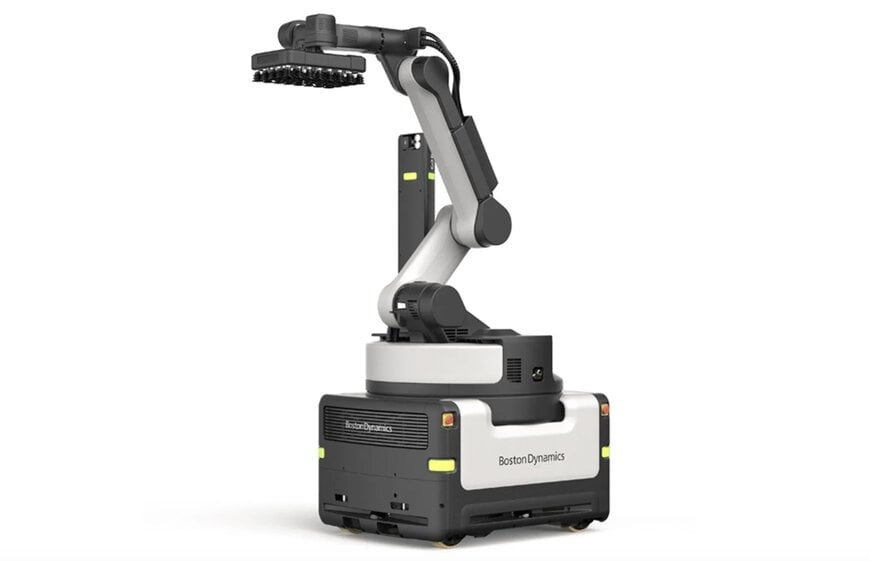
To address downtime drivers identified across real-world logistics hubs, Boston Dynamics unveiled Stretch Gen 2, the next iteration of its autonomous mobile robot designed specifically for inbound box unloading. The updated platform incorporates design modifications derived from analyzing more than 100,000 operating hours and tens of millions of packages handled by first-generation Stretch deployments.
The mechanical redesign focuses heavily on uptime maximization and field maintainability. Stretch Gen 2 cuts internal cabling by 81 percent, removing approximately a half-mile of internal wiring to eliminate a primary source of intermittent electrical faults, wire fatigue, and routing wear. Critical connections are upgraded with heavy-duty automotive-grade connectors that resist ongoing shock and vibration caused by rapid box manipulation and transit across rough dock floors.
In parallel, new arm and manipulator joints rotate continuously beyond 360 degrees without hitting mechanical hard stops, removing cyclical mechanical stress and avoiding joint unwinding maneuvers during dynamic path planning. A redesigned vacuum gripper incorporates enhanced valve manifolds and high-precision tactile sensing, improving grasp security, pick speed, and placement accuracy across variable packaging materials. To prevent incidental damage, recessed and repositioned emergency-stop buttons prevent falling boxes from accidentally triggering nuisance safety shutdowns, while ruggedized exterior composite panels resist cosmetic and structural damage from dropped cartons.
The system's modular layout enables rapid component replacements on-site. Major assemblies such as the full swerve-drive module can now be replaced in approximately one hour instead of an entire working day. Standardized fasteners and integrated diagnostic tools allow in-house warehouse maintenance teams to perform routine repairs without waiting for third-party OEM field service technicians.
Throughput Metrics, Dynamic Power, and AI Computing
Stretch Gen 2 operates at unloading speeds of up to 1,000 cases per hour, leveraging a dynamic multipick feature to unload multiple boxes simultaneously when handling uniform or structured freight walls. Unloading velocities vary dynamically based on package weight, carton integrity, and the regularity of stacking within the trailer.
The robot is powered by an onboard battery pack providing up to two full shifts of continuous autonomous operation, supported by a fast-charging dock that replenishes the battery to 90 percent state of charge in approximately 75 minutes. Integrated high-output lighting enables autonomous operations inside dark, unlit 53-foot trailers and intermodal sea containers. Operating on a redesigned onboard computing module, the platform runs pre-trained deep neural networks capable of zero-shot case detection from day one without site-specific CAD teaching. Over-the-air fleet software updates periodically deliver continuous enhancements in collision avoidance, dynamic motion planning, box-grasping heuristics, and 3D environment modeling across deployed fleets.
Additional Context
This section details technical specifications and competitive benchmarking not included in the original product announcement.
In industrial mobile manipulation and automated logistics, dockside container unloading systems must operate in accordance with safety standards such as ANSI/RIA R15.08 for industrial mobile robots and ISO 3691-4 for driverless industrial trucks. Maneuvering inside standard ISO containers and dry-van trailers presents severe spatial boundaries, where an interior width of roughly 2.4 meters and heights below 2.7 meters leave minimal clearance for a high-payload arm to articulate while maintaining safety margins. Conventional industrial robots typically route cabling through external dress packs that catch on box corners or experience localized fatigue during high-speed wrist articulation. By utilizing continuous slip-ring architectures or hollow-shaft internal routing to eliminate 81 percent of internal wire length, Stretch Gen 2 reduces bending radius strain and capacitive signal degradation across its Ethernet and power distribution buses.
Within the robotic truck and container unloading space, Boston Dynamics’ Stretch Gen 2 benchmarks directly against emerging mobile manipulation systems including the Dexterity Mech/Dexterity Palletizing and Unloading system, Mujin TruckBot, and Pickle Robot Company’s Unload system, as well as fixed or extendable gantry unloaders from suppliers like Honeywell Intelligrated and Siemens Logistics. While competitors such as Mujin deploy conveyor-linked gantry rollers or cantilevered boom arms that restrict maneuverability across multiple dock bays, Stretch utilizes an omnidirectional four-wheel independent swerve-drive base paired with a counterweighted crane-arm kinematic profile. This allows the system to move freely between adjacent dock doors, rotate within its own footprint, and maintain continuous case feeding to flexible dock conveyors without requiring floor tracks or permanent structural facility modifications.
Edited by Romila DSilva, Induportals Editor, with AI assistance.
www.bostondynamics.com
