
www.usa-automation.net
22
'26
Written on Modified on
Falkor Deploys Spatial AI Agents for Industrial Plants
Falkor integrates NVIDIA Omniverse and Microsoft Azure AI infrastructure to automate plant maintenance planning and inspection prioritization using spatial reasoning.
www.kongsbergdigital.com
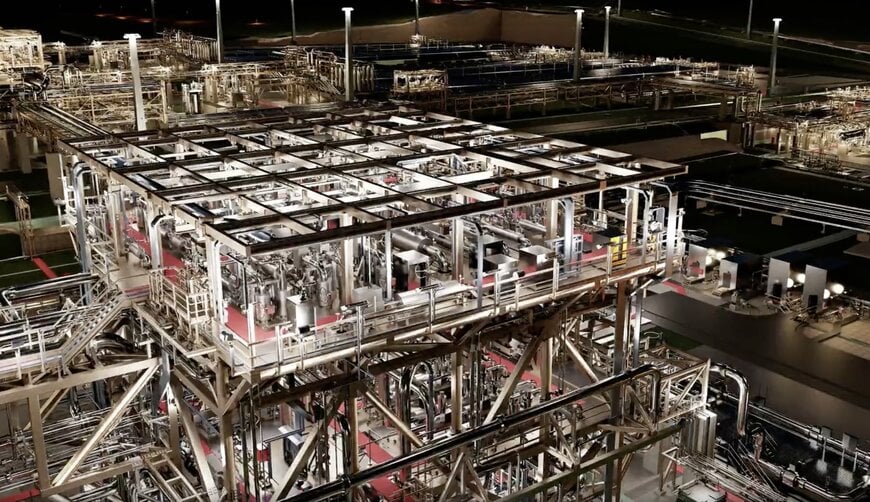
Operating complex industrial assets—such as offshore oil and gas platforms, chemical refineries, and utility networks—presents substantial operational maintenance and inspection planning hurdles. Conventional enterprise software and generative AI platforms primarily process tabular data, maintenance records, and text-based piping and instrumentation diagrams in isolation. Because these systems lack spatial context, they cannot evaluate real-world physical constraints such as crane hoist reach, component clearances, work-crew access routes, and dynamic plant layouts. Consequently, engineering teams spend excessive manual effort gathering physical evidence and conducting field cross-checks before executing hazardous maintenance tasks. Resolving these bottlenecks requires physics-based spatial intelligence capable of binding physical asset geometry to live operational telemetry.
Spatial Intelligence and Physical AI for Maintenance Planning
At NVIDIA GTC Berlin, Falkor (formerly Kongsberg Digital) demonstrated artificial intelligence agents with spatial intelligence designed to see, simulate, and reason over physical operating facilities. Developed in collaboration with NVIDIA and Microsoft, the system operates within the Falkor Surface interface on Microsoft Azure AI infrastructure, building on foundational collaboration initiatives introduced at Hannover Messe.
Rather than restricting analysis to static paperwork, the AI agents evaluate 3D physical parameters alongside equipment histories. In a reference industrial facility test involving 4,847 piping flanges, an agent analyzed spatial exposure, historical inspection records, live process temperatures, and concurrent work orders to isolate 25 high-priority candidate flanges for engineering review, providing engineers with traceable reasoning and visual evidence for every recommendation. In broader maintenance planning, agents simulate physical clearances and equipment access routes using interactive physics engines, allowing operators to detect layout conflicts and test rigging plans in simulation before mobilizing field crews.
Automated OpenUSD Modeling and Digital Twin Graph Integration
Industrial plants rarely maintain pristine, unified computer-aided design (CAD) files, often relying on legacy drawings and disparate operational databases where the as-built reality diverges from historical engineering plans. To bridge this gap, Falkor deploys an automated CAD Import Engine that converts native engineering files into simulation-ready Universal Scene Description (SimReady OpenUSD) assets embedded with NVIDIA Omniverse libraries. Geometric entities resolve directly back into the facility’s digital twin knowledge graph, allowing scenes to regenerate dynamically when baseline CAD models update.
The Falkor Platform composes modular NVIDIA Omniverse core libraries—including ovstage for scene graph operations, ovrtx for RTX ray tracing, ovphysx for physics calculations, and ovstream for low-latency browser streaming—powered by cloud-hosted NVIDIA RTX PRO 6000 Blackwell Server Edition GPUs on Azure. Where current 3D CAD records are absent, AI agents powered by OpenAI’s GPT-6 Astra reconstruct OpenUSD environments directly from 2D isometric drawings and P&IDs, registering them to as-built laser scan point clouds accessed via Microsoft Foundry.
Additional Context
This section details technical specifications and competitive benchmarking not included in the original product announcement.
In industrial plant digital twins and asset integrity management (AIM), spatial AI benchmarking centers on data interoperability across ISO 15926 and ISO 14224 plant taxonomies and deterministic physics simulation performance. Standard enterprise asset management (EAM) platforms such as SAP Plant Maintenance and IBM Maximo track maintenance records, mean time between failures (MTBF), and risk-based inspection (RBI) intervals, but lack native 3D spatial awareness, requiring maintenance planners to manually reconcile 2D drawings against separate 3D design models in tools like AVEVA Everything3D or Bentley OpenPlant. By utilizing OpenUSD as an extensible scene description layer, Falkor's architecture bridges hierarchical tag-based plant data structures with geometric bounding boxes, collision meshes, and kinematic joint constraints.
Within the industrial metaverse and spatial computing sector, Falkor's platform competes conceptually with spatial intelligence initiatives from Siemens (integrating Teamcenter and NX with Omniverse), Bentley Systems (iTwin platform), and Dassault Systèmes (3DEXPERIENCE). While legacy engineering platforms historically ran proprietary desktop CAD engines that struggle to scale rendering across distributed web browsers, deploying containerized Omniverse libraries (such as ovphysx and ovrtx) on Blackwell architecture server GPUs enables remote pixel streaming over WebRTC via ovstream. Furthermore, integrating multi-agent reasoning over Model Context Protocol (MCP) servers allows frontier language models to query spatial APIs deterministically, isolating simultaneous operations (SIMOPS) clashes and safety exclusion zones without requiring manual geometric drafting.
Edited by Romila DSilva, Induportals Editor, with AI assistance.
www.falkor.com
