
Digital Machining Replaces Chemical Milling in Aircraft Fuselage Production
Fives HPM’s Mirror Milling Star reduces production time by 65% and electricity consumption by 50%, improving precision, productivity and sustainability.
www.fivesgroup.com
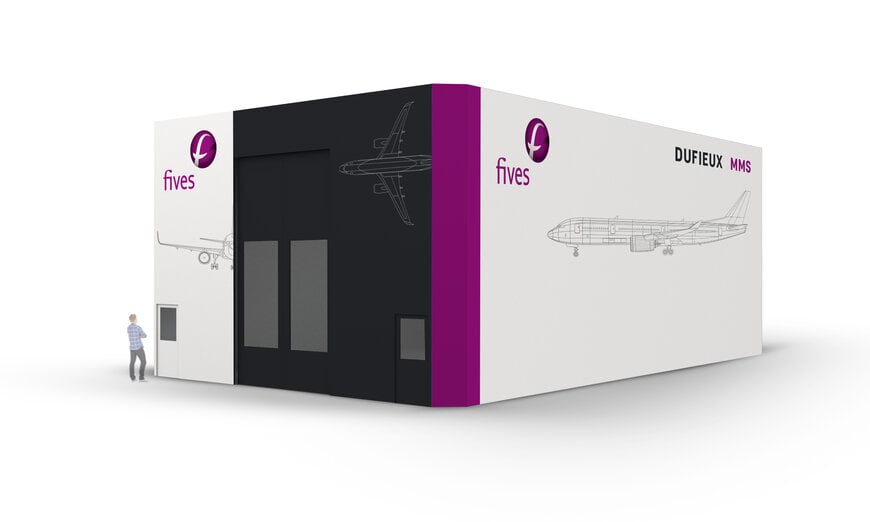
The evolution of high-accuracy mechanical machining for use on fuselage panels reflects ‘precision at scale’, the ethos of Fives High Precision Machines (Fives HPM) that underpins its newly unified brand portfolio. Marrying a broad range of advanced machining and manufacturing technologies under a single identity, Fives HPM blends engineering expertise with an established U.S. network of production facilities and customer support teams to help the aerospace sector overcome core challenges.
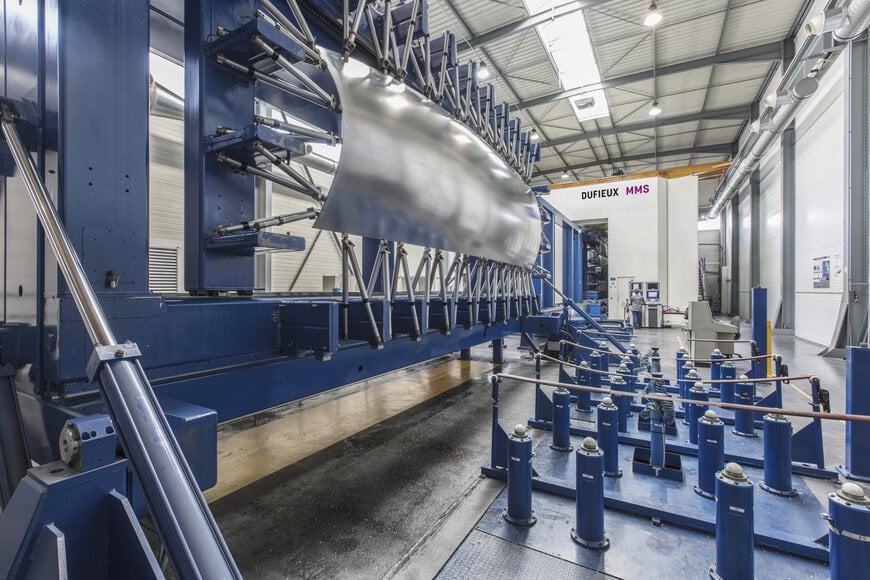
A pertinent example is the Mirror Milling Star (MMS), a digital machining solution developed specifically to replace conventional chemical milling in the production of large aluminum or composite fuselage panels.
While chemical milling is largely limited to pocketing operations, the MMS performs high-speed milling, drilling, and trimming on a single platform. Manufacturers benefit from greater flexibility, fewer process steps, significantly improved productivity, and a more circular production process in terms of recycling opportunities - all while maximizing dimensional precision.
Beyond Chemical Processes
Chemical machining has served the aerospace industry well, but its shortcomings are increasingly difficult to ignore. The process depends on hazardous chemicals that require specialist storage, handling, and disposal, creating environmental obligations alongside higher operating costs. Offering relatively little flexibility, chemical milling also occupies considerable factory space and consumes high amounts of electricity.
MMS removes many of these constraints while simultaneously expanding manufacturing capability. Notably, the system leverages intelligent digital technologies to adapt every machining cycle to the actual geometry of individual panels.
The result is a process that delivers consistent accuracy, even when machining large, thin-walled aerospace structures with complex 3D contours. Precision at scale.
Adaptive Digital Precision
The foundation of the system is advanced surface scanning capability that measures the real shape of every formed panel before machining commences. Rather than assuming each panel perfectly matches its CAD model, the machine recognizes that forming processes inevitably introduce minor variations. Capturing those differences at the outset supports automatic compensation routines during machining.
Fives' proprietary Scan & MAP (Milling Adaptive Process) is the facilitating technology. After a high-resolution laser scan, software reconstructs the panel's true geometry, morphs the theoretical machining program to match the measured surface, and automatically generates the optimal tool path. Instead of forcing the panel to conform with an idealized model, the machining program adapts to the actual geometry.
This distinction is vital when producing large aircraft skins, where maintaining highly accurate pocket depths directly influences both structural performance and aircraft weight. Through dynamic adjustment of the machining path, manufacturers can achieve exceptional dimensional accuracy.
12-Axis Synchronization
A key differentiator of MMS is its patented mirror machining architecture. Two synchronized six-axis heads operate simultaneously on opposite sides of the panel. One incorporates the high-speed electro-spindle, while the second provides continuous panel support. By maintaining contact with the workpiece throughout the machining cycle, it becomes possible to minimize vibration and maximize stability.
Together, the 12 synchronized axes respond dynamically as machining progresses, with an ultrasonic sensor continuously measuring the remaining material thickness. This capability enables the system to verify pocket depths in real time rather than relying exclusively on post-process inspection. The combination of adaptive machining, active support, and continuous measurement is powerful for manufacturers: it provides exceptional control over panel symmetry and wall thickness, regardless of geometry.
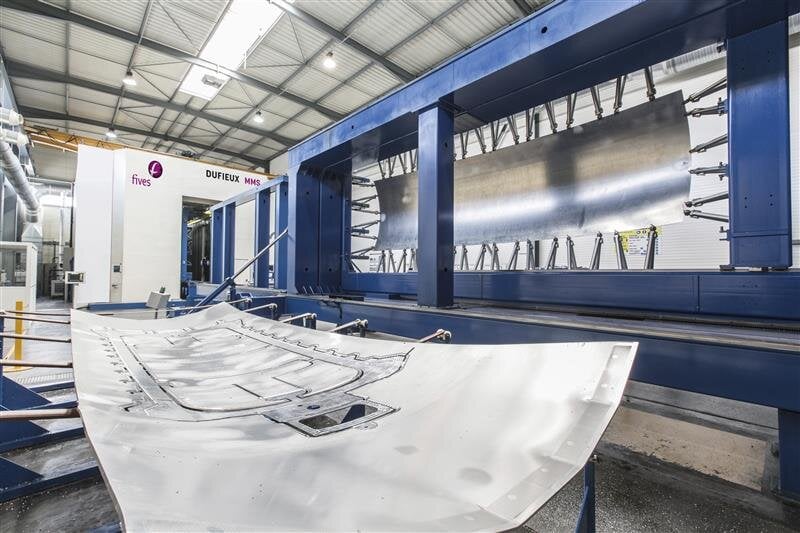
The machine also replaces conventional dedicated fixtures with flexible universal holding frames that accommodate multiple panel designs without introducing workpiece stress. Besides reducing tooling investment, this approach simplifies panel handling and permits the machining of both panel sides without unclamping. The outcome? Better repeatability and less non-cutting time.
Connected Manufacturing Intelligence
Digital advantages extend far beyond the machining operation itself. Rather than functioning as a stand-alone machine tool, MMS forms part of a connected manufacturing environment encompassing programming, production, inspection, process analysis, and continuous improvement.
Dedicated Fives software simplifies programming by automating many previously manual operations and driving substantial reductions in set-up time. During machining, the system simultaneously records tool position together with quality and process data, creating a 3D digital representation of the finished panel as production progresses.
This information flow provides valuable insight into both product quality and machine performance. Integrated inspection capabilities reduce reliance on separate measurement routines, while secure data collection supports predictive maintenance, traceability, and broader Industry 4.0 initiatives. Manufacturers gain far greater visibility of the entire process, leading to faster decision-making and continuous optimization.
Savings and Sustainability
The practical benefits are substantial. Compared with chemical milling, manufacturers can reduce production time by as much as 65% while cutting factory floor requirements by around half. Electricity consumption also witnesses major reductions, typically up to 50%, lowering both operating costs and carbon emissions.
Further environmental benefits include eliminating the need for storing, transporting, treating, and disposing of chemicals. Instead of generating hazardous, unusable sludge, MMS produces aluminum chips for recycling, creating additional revenue.
Perhaps equally important is the breadth of applications supported by the technology. In addition to fuselage panels, MMS has proven its capabilities on aircraft canopy structures, landing gear reinforcements, and complex waffle components used in space launch vehicles.
Precision at Scale
Originally developed in collaboration with Airbus and continuously refined over more than two decades, MMS systems are now producing tens of thousands of fuselage panels every year for leading aerospace manufacturers worldwide. Their continued evolution reflects a broader cross-industry trend, where digital intelligence is becoming just as important as machining capability.
As part of the unified Fives HPM portfolio, the MMS demonstrates how the company's ‘precision at scale’ mantra translates into practical manufacturing solutions: imparting high levels of accuracy into large machined components. Supported by extensive engineering expertise, lifecycle services, and a strong U.S.-based support network, word is spreading fast about this advanced technology. Why? Because it allows aerospace manufacturers to move beyond legacy chemical milling and embrace a smarter and more productive approach to machining next-generation fuselage panels.
www.fivesgroup.com
