
www.usa-automation.net
06
'26
Written on Modified on
Group-level AI robotics strategy and industrial deployment
Hyundai Motor Group and Boston Dynamics present a coordinated AI robotics strategy at CES 2026 focused on human–robot collaboration and industrial-scale deployment.
www.hyundaimotorgroup.com
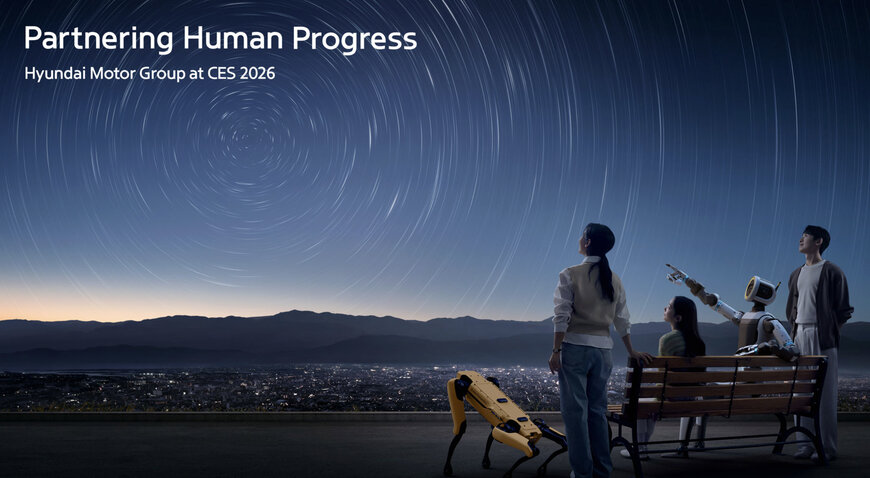
Hyundai Motor Group will use CES 2026 to outline a group-wide AI Robotics Strategy that integrates robotics development, software, and manufacturing systems. The cooperation with Boston Dynamics positions robotics as an operational component across industrial production, logistics, and service environments.
Context of the cooperation
Hyundai Motor Group’s robotics activities combine vehicle manufacturing, smart factory development, and autonomous systems under a unified technology roadmap. Boston Dynamics operates within this structure as the Group’s core robotics developer, responsible for advanced mobility, manipulation, and control platforms.
The cooperation addresses a common industrial challenge: moving AI-enabled robots from research environments into scalable, safe, and economically viable real-world applications. This transition requires alignment between robot design, software architectures, manufacturing processes, and operational data flows—capabilities distributed across the Group’s value network.
Technical strategy and system architecture
At CES 2026, Hyundai Motor Group will present its Group-level AI Robotics Strategy under the theme “Partnering Human Progress.” The strategy emphasizes human–robot collaboration rather than full automation, with a focus on adaptability, safety, and task-level intelligence.
A key technical foundation is the Group’s Software-Defined Factory (SDF) approach. SDF combines physical manufacturing assets with software-based control, data integration, and simulation to enable flexible production and continuous optimization. Within this framework, AI robots are treated as software-integrated assets rather than standalone machines, allowing unified management of perception, motion control, learning, and deployment.
Next-generation robotics platform
Boston Dynamics will publicly demonstrate the next-generation Atlas humanoid robot outside laboratory conditions for the first time. The new Atlas is positioned as a platform designed for industrial environments, with an emphasis on balance, manipulation, and adaptability to unstructured tasks.
The demonstration highlights a shift from prototype development toward commercialization. Rather than focusing on single-use scenarios, the system is designed to be trained, updated, and redeployed across multiple operational contexts.
Training, learning, and deployment model
Hyundai Motor Group plans to manage the full robotics lifecycle—from component development and AI training to field operation—through integrated group capabilities. This includes robot hardware, logistics integration, and software platforms that support learning and continuous improvement.
Robotics training and expansion are structured to leverage operational data from manufacturing and logistics environments, enabling iterative performance optimization and scalable deployment across the Group’s industrial footprint.
Applications and use cases
During CES 2026, Hyundai Motor Group will host an interactive exhibition featuring practical AI robotics applications. Demonstrations will include Atlas, Spot, and MobED platforms operating in scenarios representative of industrial workspaces and daily environments.
These use cases illustrate how AI robotics can support process stability, operational flexibility, and safer human–machine interaction when integrated into existing digital infrastructure.
www.hyundaimotorgroup.com
