
Electric Cylinders Enable Precise TIG Welding Of Thin Membranes
An international measurement technology manufacturer integrated electric cylinders and linear axes from HIWIN to achieve reproducible torch positioning in precision TIG welding.
www.hiwin.com
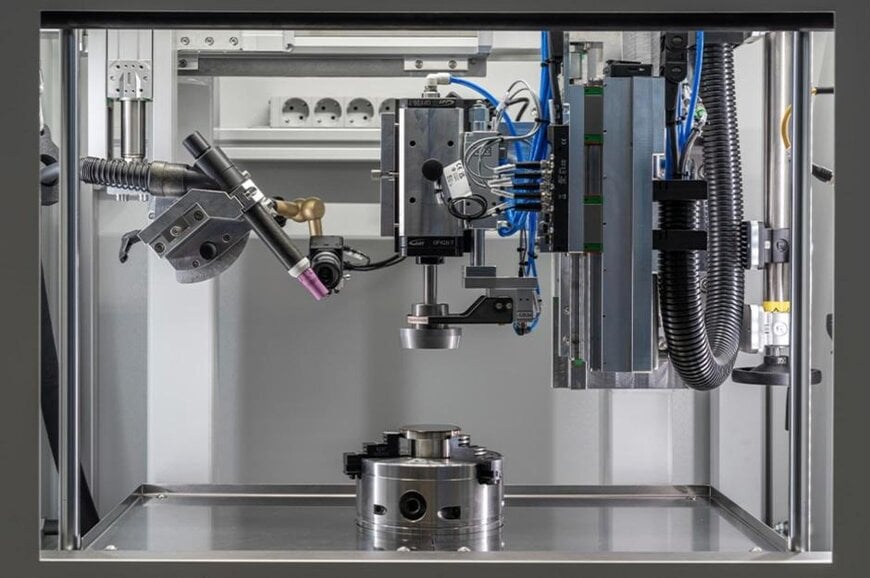
An international measurement technology manufacturer required a specialised production system for joining thin-walled metal membranes in the micrometre range to solid components using Tungsten Inert Gas (TIG) welding. In this process, even minimal deviations directly compromise weld seam quality. Although the individual components exhibit manufacturing tolerances in the tenth-of-a-millimetre range, the assembly process demands consistently high repeatability and process reliability. Pneumatic and hydraulic drives proved unsuitable for these tight tolerances, prompting the engineering team to seek a compact, controllable electric motion solution capable of operating within restricted installation space.
To meet these positioning requirements, the manufacturer developed an in-house welding system equipped with drive and linear motion components from HIWIN. The kinematic architecture combines an HT-S 100 spindle-driven linear axis, which positions the welding unit along the main axis, with CGH 20 and CGL 15 profile rail guides from the CG series to ensure rigidity and guidance accuracy. For fine positioning of the tungsten electrode relative to the workpiece, the engineers integrated the EA-S 50 electric cylinder, which HIWIN first presented publicly at automatica 2025 in Munich. Before each welding cycle, an automated probing function detects the actual component position, allowing the drive system to compensate for manufacturing tolerances and approach defined process positions with high reproducibility.
Compact System Design And Series Deployment
The selection of the electric cylinder was driven by its combination of a compact design, an integrated guide and a 300-millimetre stroke. "The 300-millimetre stroke was an essential criterion for us. We found no comparable product on the market that combines this travel length with a corresponding guide," explained a project manager. The integrated guidance eliminated additional structural components and maximised the use of limited installation space to accommodate varying workpiece diameters. "Due to the tight tolerances, positioning accuracy was decisive. Pneumatics or hydraulics were therefore not a realistic option," noted a member of the system development team. Sourcing the core motion components from a single supplier reduced mechanical interfaces and simplified system integration. During the design phase, the engineering team used HIWIN's digital sizing tools alongside verification calculations by the supplier's field service. Following validation of the initial concept, the manufacturer built a total of ten welding systems, establishing a technical foundation for future production equipment.
Edited by Maria Brueva, Induportals editor – adapted by AI.
